Friday, April 26, 2013

Overlook of political parties and candidates in upcoming Iran election (june)


On June 14th, Iran is going to have a presidential election that has international observers watching closely, and making their own predictions. The variety of factions and candidates are going to lead to interesting political developments. This election seems to be particularly close, with international observers as clueless as the citizens of Iran. While previous elections have featured two main-stream political factions called the Principlists(right leaning conservatives) and reformists (the far left) Principlists include multiple coalitions, independent candidates, and Perseverance Front; the Reformists include moderate and radical figures, s well as government affiliates. This post will give a quick overview of the groups running in the next election.

The Principlists are right-wing conservatives who hold the values of the 1979 Islamic revolution, but differences in opinions have prevented them from gaining solid ground in the election. They are divided into 3 sub-categories. The first is the Coalition of Three, which according to polls, is the most popular out of the three and represents the mainstream conservative group. The next group, the Coalition of Five, was formed from five traditionalist conservatives, including Manouchehr MOttaki, foreign Foreign Minister, and Mostafa Pour-Mohammadi head of the general inspection Office of Iran, and former Interior Minister. According to the article, analysts insist that this group has no chance of winning the presidency.

The last group of the Principlists is the Perseverance front, which are made up of political activists who strongly supported Ahmadinejad until 2010. This group also includes candidates who have held prominent positions, including MP’s Ruhollah Hosseinian and former Health Minister Kamran Baqeri-Lankarani. The Perseverance Front won an impressive hundred out of 290 seats in Parliament in the March 2012 election. Their downfall is in their indecisiveness because the group hasn’t managed to agree on a candidate.
This time around the spotlight includes some independent candidates hoping to win or make a difference. Mogsen Rezaei is the most famous of the independents, and was the former head of the Islamic Revolution Guards Corps. He is also the current secretary of the Expediency Council, and has a loss from a previous run at the presidency. Other independent candidates have no chance of winning the election.

The Reformists are divided ino radicals and moderates. The

 moderates think Mohammad Khalami, who was president 

from 1997 to 2005, believe he should succeed Ahmadinejad. 

They think he has a shot at winning even though some analysts 

believe he might be disqualified. Moderate Reformists haven't 

decided on a nominee yet and are choosing between former


chief nuclear negotiator Hassan Rohani, former Reformist MP

 Mostafa Kavakebian and former VP Mohammad Reza-Aref

. Former Commerce minister Mohammad Shariatmadari is 

also a Reformist potential candidate.

The current President Ahmadinejad wants to stay in power, but

 he can't run for a third term, so instead he is looking for a 

suceessor close to his views. He has been grooming Rahim 

Mashaei for presidency, who is currently influential in political 

disputes. The article concludes that Reformists and pro-

Agnadinejad political activists aren't likely to win the election in

 June. Overall the candidates seem scattered, but the high 

number of parties and candidates are going to make it a very interesting campaign for the entire world.

Top 10 Movies Banned in the Middle-East


Blog Post-
Leo Rechetniak
Make Films not War

1)


             This article on frontpagemag relays the top ten American movies banned in the Middle-East. Its super interesting because movies that we consider to be awesome or normal, might be banned in Middle-Eastern countries for having questionable content or depicting values/images contrasting to their norms. “Cultural advisor Javad Shamaghdari told the Hollywood reps exactly what Iran wanted: “We will believe Obama’s policy of change when we see change in Hollywood too.” It's fascinating that their perception of us and our policies are influenced so heavily by out movies. Most interesting are some of the reasons why these films were banned, and highlight the stark contrast of views, values, and ideas between our culture and theirs.
         
              One movie, with an already notorious reputation, called Not Without My Daughter, and is based on the book as well as one more “Salman Rushdie's infamously blasphemous The Satanic Verse. It depicts an escape of an American citizen and her daughter from Iran, and was banned for embarrassing the mullahs and for exposing oppression and harsh reality of life. The Matrix Reloaded, one of the U.S.'s most popular movies of all time, was banned in Egypt in 2003 by a 15 member censorship committee. It was banned for having alternative concepts of divinity and free will, as well as the violence. Some Egyptian movie critics claimed it “promoted Zionism”.

             Alaxander, a film depicting the life of Alexander the Great, in which Alexander demolishes the Persian army, under rule by Darius III, and destroyed the royal palace, ending the Persian empire. Another Persian related movie, 300, super popular in the states and very violent, shows the famous Spartan force killing waves of Persians, who are “depicted as being decadent, arrogant, and imperialistic”, which interestingly enough are “the same charges Ahmadinejad and the mullahs” accuse the United States of. In their eyes, that movie was released to humiliate them. They seem rather self-conscious about the whole Persia thing, and incredibly defensive and proud of their heritage. It reminds of paranoid people in high-school who always thought people were talking about or laughing at them. Quite sad, really, as 300 is an imaginative look at a historical event, and its worth mentioning its incredibly unrealistic.
                  
             Sex and the City 2 was banned simply because “the theme of the film does not fit in with cultural values”. These are only a few movies from what I imagine to be a very large list of banned movies, books, and likely music. I believe censorship goes against a fundamental human right, so its crazy to me, but they live in such a different world its almost understandable. And just because the movies are banned “that doesn’t mean that such movies don’t circulate underground; in very Westernized Iran, for example, the mullahs do their best to keep a lid on the populace’s preference for American cultural decadence, but pirated DVDs are eagerly consumed by viewers privately. “ People will always find a way to find and watch banned content, and they have all throughout history. Technology is making any kind of ban on media pretty much worthless.


OFFSIDE- movie review

http://www.tubeplus.me/player/395421/Offside/ . Full movie found at this link. Perfect Quality.
Leo Rechetniak

Offside- :Movie Review

             I was really interested in this movie when I saw the preview in class. It starts off with a father looking for his daughter, who is in disguise as a boy and is trying to sneak into a football match. Its a losing battle for the father, who is overwhelmed by the bus's full of screaming football fans. He's extremely worried for her safety; “they'll kill her”, he says in the opening scene of the movie.

              Its suspenseful, and all of the build up makes you worried about the girl and what could happen to you. Her disguise doesn't seem to be very effective, as the boys in the bus, and trhe man selling merchandise who sold her a ticket all saw her for what she was. She buys the ticket at a ridiculous mark-up and looks for the way inside. Going through the gate is intense, and they end u[ recognizing her as a girl almost immediately, and is caught trying to run away. A guard leading her away asks to borrow her cell phone and its actually pretty funny as he gets a call back from a girl and argues on the phone, making it seem realistic. She's not the only prisoner, and not the only girl, in a temporary jail cell. The guards don't seem to be as intent on killing her as her father made it out to be, but seems to be more about keeping her out of trouble. The prisoners manage to convince one of the guards to at least commentate on the game. One of the guards is empathetic to the girls, while the other is less pleasant.

              Overall I found this movie both funny and thought-provoking. I didn't expect the humor aspect to pop up as much as it did. The guard who takes one of the girls to the bathroom, disguised under a poster, is hilarious; he single-handedly tries to hold off a dozen soccer fans from going into the bathroom while she is using it(before she manages to escape). Its an extremely clever movie showing that foreigners can be just as crazy, if not crazier, about their sports as people in the United States.
           
             Not only does is seem realistic or even improvised, but the characters perfectly fit into the movie. It makes its point about woman's rights while keeping it light and entertaining. It's sad when the girl explains that she was never interested in football, but wanted to attend a match to honor the memory of a friend of hers killed during a recent soccer match. The sadness is overshadowed by celebration as Iran wins the match against Bahrain and the soldiers and girls join the people celebrating. When searching for the film I was interested to read that the film makers had two different endings planned depending on the outcome of the match, since it was filmed at a real stadium during and actual game, making the filming process even more impressive. Overall 4.5 out of 5 stars.

Wednesday, April 24, 2013

Matt Upshall

This article discuss' what Guez refers to as a "minority within a minority". In this case he is referring to Palestinian Christians who are struggle to have their cultural identity recognized by both the Jewish and Muslim society. The versatility of the Christian minority should be known.

http://www.cnn.com/2013/04/11/world/meast/dor-guez-christian-palestinian-art/index.html

Tuesday, April 23, 2013

Sex manual offered to ultra-Orthodox Jews

http://www.bbc.co.uk/news/magazine-22152700

     I recently found this article, which talks about the difficulties encountered when trying to discuss the subject of sex in Orthodox and ultra-Orthodox Jewish society. Though sex is regarded positively by Judaism, it has become taboo to discuss it openly. Ultra-Orthodox boys and girls are educated separately, most often at special religious schools, where they receive little or no sex education. Physical touch with the opposite sex - even something like a handshake - is only permitted with one's spouse and close family members. Access to films and the internet is often restricted. Then on their wedding night, after spending their entire lives having minimal interaction with members of the opposite sex, these young men and women are expected to consummate their union.
     Dr. David Ribner, a Jewish sex therapist and counselor living in Jerusalem, noticed an issue here. "Sex is only appropriate within a marital context," he says. "Beyond that it's not talked about. Because of that, it's become very difficult for people to have any kind of dialogue about it."
     To help solve this problem, Ribner has written and published The Newlywed's Guide to Physical Intimacy, sex manual for Orthodox Jews. The book was released last year in English, and is about to be published in Hebrew. It uses simple diagrams (kept in a sealed envelope in the back) and direct language to speak openly about sexuality to its Jewish audience.
     Those interviewed in the article predict the book "will meet tremendous negative reaction - at least within the most extreme elements of the ultra-Orthodox Jewish community." However, they all agree that The Newlywed's Guide is long overdue, and will be very beneficial to their community as a whole.

Monday, April 22, 2013

Nettleton


This article recounts the growing tolls of violent protests in Iraq over the past week. Over 50 protestors were killed by security forces in a single instance at a rally that was intended to be a peaceful sit-in. The army claimed that the protestors had fired first, and that they merely responded appropriately. It hardly matters who fired first of course, as these are escalations of previous conflicts. The week before, dozens of Shia Muslims were killed in bombings. More undoubtedly died in the weeks before.
The conflicts are the result of Prime Minister Nuri al-Maliki’s apparent oppression of Sunni populations in Kirkuk. Leading up to provincial polls in the area, over a dozen political candidates have been murdered, and the actual vote has been put on hold in a number of areas. While political killings are not unexpected when dealing with corruption, it is unfortunate that, more often than not, it is the innocent citizens who must suffer the most just to see these proceedings to their conclusion. And even then, it is unlikely that anything will change, considering that the political power in the region comes directly from Baghdad.

European Union Assists Syria

Ben Heitmann
4.22.2013
COR 330-09
Prof. Esckilsen

Blog Post #5: European Union Assists Syria

            This article from the BBC discusses a new change being made by the Council of the European Union in regards to Syria. As many of us know, Syria is currently in the midst of a massive civil war between President Bashar al-Assad’s loyal forces and the uprising Free Syrian Army rebels. So far, the war has gone on for over two years and has done some serious damage. All across the nation, tens of thousands of lives have been taken, and the economy continues to suffer. In hopes of reducing this economic hardship, the European Union has decided to lift the oil embargo that was previously put on Syria.
            The changes to this embargo will allow European companies to “import crude oil and petroleum products from opposition-held areas” (The BBC). This shows the EU’s support for the FSA rebels, and disregard for al-Assad and his military. Essentially, the European Union wants the opposition in Syria to prevail against its oppressive government. Reactivating oil trade between Syria and Europe will allow the rebels to make significant monetary gains. Exporting crude oil from Syria will potentially yield a high profit, while importing equipment and technology will allow oil extraction and other related processes to improve.
Even though the Syrian oil embargo is being eased up, some restrictions and rules will still apply to their trades. First of all, the National Coalition for Syrian Revolutionary and Opposition Forces must approve each individual transaction. As it stands today, it is believed that “most of the oil fields” in Syria “are now controlled by rebel groups” (The BBC). Capturing these locations was great foresight by the opposition, as they must have realized how beneficial Syrian oil could become once the embargo was lifted. Although the state of the country is still looking quite grim, the economic future of the Syrian rebels may be looking up thanks to the European Union.

Sources

http://www.bbc.co.uk/news/world-middle-east-22254996

Tensions Rise in Jordan over Syrian Refugees

The article depicts the current economic troubles that are now facing Jordanians due to the prolonged conflict in Syria. Since the start of the Syrian civil war, more than 500,000 Syrians have fled to Jordan in hope to escape the fighting. What initially started as an open welcome to the Syrians, has now turned into its own crisis.

The majority of Syrians coming into Jordan are from rural areas and considered low-skilled workers. The low-skilled labor force has risen dramatically with some working illegally for extremely cheap. Many Jordanians are now losing work and are openly blaming the Syrians as the reason. It is to the point where Jordanians are considering “taking matters in our own hands.” The country is becoming over-saturated with workers and people with little hope of change. With people getting angrier and an apparent lack direction from the government, hostilities may rise.

I find it surprising that Jordan did not have a more prepared approach to the refugee problem with their past of helping both Palestinian and Iraqi refugees. Perhaps the issue is the sheer volume and duration of this conflict has left them unprepared. It would be unfortunate to see the Syrians who were trying to escape a conflict walk straight into another one.

Article: http://www.washingtonpost.com/world/middle_east/in-jordan-tensions-rise-between-syrian-refugees-and-host-community/2013/04/21/d4f5fa24-a762-11e2-a8e2-5b98cb59187f_story_1.html

Palestinian prisoner to end hunger strike

Herman, Arthur. "Why Israel Will Rule the New Middle East Read More: Http://www.foxnews.com/opinion/2013/01/31/why-israel-will-rule-new-middle-east/#ixzz2RFZbgEfK." Foxnews.com. Fox, 31 Jan. 2013. Web. 22 Apr. 2013.
 
The article discusses the recent actions taken in the case of Samer al-lssami who was arrested on conspiracy charges after he crossed from his native East Jerusalem to the occupied West Bank.  Officials said he was arrested for his "continued involvement in attempting to establish terror cells."  lasswi has agreed to stop his on-off hunger strike that has lasted over 8 months after officials dropped the conspiracy charges and lowered his sentences to only another 8 months.  This decision is in response to the riots and protests that have broken out due to lssawi's fasting.  The Israeli government could see what the death of a civilian can spark and they did not want a fruit cart vendor situation on their hands.    

In Syria on Sunday massive amounts of bodies were found. 556 people were killed in a six day period, and 450 of the bodies were found in Damascus alone. Some estimate that nearly 70,000 have been killed so far in Syria. The most recent attack came from a group of nearly 3,000 soldiers storming an area of activists. Nearly 150 were activists while 300 were civilians. There attacks are clearly getting worse and worse, and the deaths are racking up. Some say these protests are linked to the events of the Arab Spring, and the wanting of freedom. Most of this movement is against president Bashar al-Assad. I found it interesting that it states that these deaths are war crimes. This is a country in civil unrest, with its civilians revolting and the UN declares the deaths as war crimes. I guess this means the events in Syria are being considered a civil war?

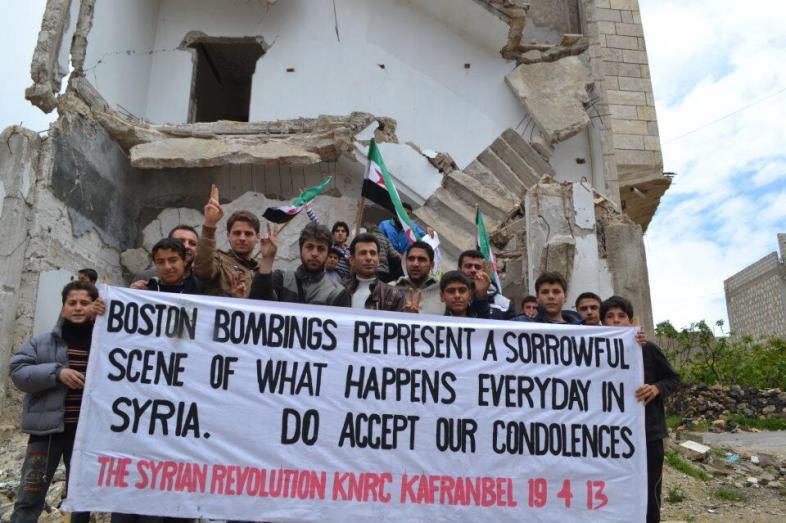
Comparison between Boston and Syria

I have heard a lot of talk lately amongst friends, colleagues, and classmates making comparisons between the Boston Bombings and what happens in select regions of the Middle East. After seeing this picture, obviously they aren't the only ones who feel this way. In roughly one week, we have had a major terror attack take place on a US holiday, the shooting of a police officer, kidnapping of a victim, identification and apprehension of the suspect(s), and have had a written criminal complaint go viral on the internet. In Syria, much more severe tragedies happen, much more often, and we never hear about who or what the reason was behind them.

This got me thinking: "Why is everyone creating this comparison between the two?" First of all, it makes us look like awful global citizens as the few times we see a name we can't pronounce scroll by at the bottom of a news broadcast, we are quick to dismiss it if there hasn't been a recent US tragedy. Secondly, I feel like this is the only country in the world where a person can be run over by his brother in a getaway chase after killing a cop and innocent people and people would be partying in the street after we caught him. Sure, it's a victor, but a somber one at best. Finally, shouldn't this make us as citizens of the world be more inclined to help out those innocent people being killed very similarly to the way they were in Boston? Just because we are separated by a significant amount of distance, culture, religion, and race does not make us all that different. They are people who have the right to live, just like us, and every day that right is overcome by radical acts of violence to enforce a political statement.

Israel ready to act on Syria weapons, warns Netanyahu


This article talks about how Israel is ready to defend themselves if Islamist militants attacks. Israel is concerned that if they have access to anti-aircraft and chemical weapons then it could be a “game changer” for the nation. Israel is concerned that if they have gain access to these weapons then they could do serious damage to Israel. “Israel has said its policy is not to get involved in the Syrian conflict” but I think that if something drastic happens they will change the policy. The Islamic militants could present a threat. “It is definitely our interest to defend ourselves, but we also think it is in the interest of other countries." 

-Katie Juhl

Middle East Weapons Deal

http://www.aljazeera.com/news/middleeast/2013/04/2013421113011380292.html

This article talks about the US's impending weapons deal with Israel, Saudi Arabia, and the UAE.  The 10 billion dollar deal includes the sale of KC-135 aerial refueling tankers, anti-air defence missiles and tilt-rotor V-22 Osprey troop transport planes to Israel as well as the sale of 25 F-16 Fighting Falcon jets to the UAE. The article states that Saudi Arabia and the UAE would also "be allowed to purchase weapons with so-called "standoff" capabilities that enable them to engage the enemy with precision at a distance."
US Defence Secretary Chuck Hagel is quoted as saying this deal is meant to send a "very clear signal" to Iran. He goes on to say, "The bottom line is that Iran is a threat, a real threat. The Iranians must be prevented from developing that capacity to build a nuclear weapon and deliver it." The US hopes to achieve this goal by strengthening the militaries of Iran's rivals.
When asked about renewed debate in the Israeli media that Israel might have to strike Iran by itself, Hagel said "every sovereign nation has the right to defend itself."
Hagel later noted that the United States and other countries still wish to solve these issues through diplomatic means.

Sunday, April 21, 2013

Israeli troops, Palestinians clash in West Bank - 5th post

 http://www.presstv.ir/detail/2013/04/19/299186/israeli-troops-palestinians-clash-in-wb/

I found this article to be used in my essay as a point to show that more and more conflicts have been happening around Israel lately.

On April 19, in a town called Silwad, a conflict broke out between Israeli armed forces and Palestinian Youths. The soldier's fired tear gas at the large crowds, and captured many of the Palestinian demonstrators. The article also went on to say that a similar conflict also broke out in a nearby town called Kafr Qaddu, and that the Palestinians claim that the Israeli's are trying to claim more land in Palestinian territory. 

I will probably use these examples as a type of conflict that happens often, and evidence that the Israeli's continuing to take territory is increasing the tension between the two sides; while making peace nearly impossible as current things stand. 

-Mitchel Hamilton

Tension on the Israel-Syria Border

Along the road to the border near Buq'ata, a town in the Israeli-occupied Golan Heights, lay rubbish and warnings signs of land mines. At the end of the road is a ridge that falls down to a plain neighboring Syria, which is where a civil war takes place. Ezat Mdali, a civil engineer who lives on the Israeli side of the border claims, "when there's action, people phone each other up and come here." Residents in the area say that they hear shooting or shelling from over the border on a daily basis. In March, the fighting was so intense that windows would shake in towns on the Israeli side of the border.

The fighting was ceased for four decades after Israel and Syria agreed on a cease-fire and the border was policed by 1,000 U.N. troops. Now, the northern border is more tense than at any time since the cease-fire was signed. Israel has been reinforcing its border fence which should be finished in July. They are also replacing the reserve troops in the Golan with regular forces. U.N. vehicles have been patrolling the cease-fire line which cuts through communities, which separates family and friends. People have been staying in touch using e-mail and Facebook.

http://www.washingtonpost.com/world/middle_east/tensions-build-on-israel-syria-border/2013/04/17/9bcca7fe-a77e-11e2-b029-8fb7e977ef71_story.html

Ariele's # 5 Blog- Link to Major

Throughout class we have talked about many things that made me wonder how me and my career will be affected.  Being a communications major I will be interacting with people all around the world which makes me wonder if I know enough about the Middle East and their struggle to be able to work with them if I ever have to.  An observation that I made from this class that links ideas and/or questions to my major is how women are treated in the Middle East.  Many of the countries allow their women to be in the business world, while some still do not.  The questions that arise for me and my major are as follows:

1. If I went to the Middle East would I be looked at negatively or differently being a women in the work force?

2. Would I have to wear the veil like most women do in the Middle East?

3. What kind of issues would I be dealing with if I ever traveled to the Middle East for work considering my major is so broad.

Many of the movies we watched show women in a bad light so it frightens me, being a woman myself as to how the Middle East view women in America as well as in other regions. 

Saturday, April 20, 2013

http://www.bbc.co.uk/news/world-middle-east-22209841

Iraq Violence: Baghdad Cafe Hit by Deadly Bomb Attack

This article details a bombing that took place on the 18th in Bagdad when a suicide bomber blew himself up in a popular internet café, killing 27 people that included two children and injuring dozens more. It followed car bombings that happened Monday all across the country, killing 31 and injuring 200. Although no group has stepped up to claim the bombings, they happened right before the election in Iraq. That the bombings happened on Monday also makes me wonder if they are somehow connected to the Boston Marathon, but is this only because I'm an American with an inflated sense of the immensity of tragedies in my own country compared to those in others?

We hear about bombings in the Middle East so often that we barely register them as realities, but the Boston bombing allows us to imagine the horror of living in a place where you could be randomly terrorized at any given moment. 9/11, of course, brought the possibility to our attention first, but the last war on our own soil happened over 150 years ago and we are used to such attacks being isolated incidents. The marathon bombing makes one fear that such tragedies could become as common as they are in the Middle East and elsewhere.

~April Patterson

Iraq Provincial Election

Today, Iraqis voted in a provincial election. This is the first election since the departure of United States troops in late 2011. It is also the first time since 2003 that Iraqi forces took charge of security in an election. Prior to the election, there has been violence within the country and the Shia led government has postponed the election in two Sunni dominated provinces. Within the past week, dozens of citizens were killed in bombings that targeted the Shia dominated provinces. Two of the polling stations have been attacked, and fourteen people who were running in the election a majority being Sunnis were murdered.

Almost 14 million Iraqis were eligible to vote in the election and were able to vote for over 8,000 candidates to fill 378 seats in the provincial council. These numbers were similar to the election back in 2009.

Prime Minister Nouri al-Maliki urged people to vote in the election. He stated, "I say to all those who are afraid for t future of Iraq and afraid of a return of violence and dictatorship that we will fight by casting ballots." Many voters were concerned of their security. A student, Abdulsahib Ali Abdulsahib mentioned that "security is the most important problem that all of them should be working for, without this, life would be so difficult." To ensure security, voters were searched twice before allowed to enter the polling stations and there were numerous security forces patrolling around the capital.

http://www.bbc.co.uk/news/world-middle-east-22229323

A clip from a TV show that I watch..."The Newsroom"

With everything that have happened this week in the U.S some people are using it as a rhetoric to construct their view and perspective of others. I think this brings us (we as a class)  back Edward Said point of the "US vs the Other" that we made earlier this semester. With 9/11 and Boston event all involving people that are consider the "other" many in the U.S have  prints a picture of the U.S being the hero

The Newsroom is a American TV series which I am addicted to.  In season 1 of  this show...the main  character (will) where asked of his opinion on "Why America is the Greatest country" and he said... (Excuse the language) 

Friday, April 19, 2013

Israel ready to act on Syria weapons

Israel is under threat from Syrian rebels after they seized an anti-aircraft and chemical weapons.  as of right now, Israeli prime minister Benjamin Netanyahu says that Israel has the right to prevent these weapons from falling in the wrong hands.  Its seems like there is never ending conflict between these countries.  The main concern Netanyahu has are the anti-aircraft weapons.  These weapons are the most dangerous and could be "game changers" on both end.  Israel is more than prepared to fight the Syrian rebels but do not want to if they don't have too.  It would be nice to see one day these two countries not in such a heated battle.

For more on this here is the full story

http://www.bbc.co.uk/news/world-middle-east-22195508

Thursday, April 18, 2013

Independence Day Reflections of the Haredim

The Haredim should have a deep connection to their holy land but this feeling is being alienated. This group appreciates everyone living in a high tech land, especially with the tremendous benefit they derive from it, but they feel they can "give [their] utmost passion to our causes without anyone killing anyone" says Avraham Edelstein. The Haredi Jews also appreciate the fact that they can get up every morning and walk freely about without discrimination. This miracle state has allowed full Haredi towns and neighborhoods to develop without an issue and are becoming closer with the state while non Haredim are also becoming more religious as time runs on. Fellowships such as the Aish Hasbara have brough close to 1000 North American Jews on trips to Israel which are almost predominantly run by the Haredim. They claim that they are "the only ones there who can effectively recruit and program to protect the State of Israel.

Along with scheduling these trips and becoming more affiliated with the state, important political roles are being filled with Haredi Jews. These include the Finance ministry, Ministry of Health, and Ministry of Housing among others. Loyalty is not depicted by whether a person is a flag waver or not. Both Haredim and non Haredim citizens are proud members of Israel. Each one should respect the other and forget about yesterdays problems. If this is done then and only then can they take a step in the right direction together.

Link to article :http://www.huffingtonpost.com/avraham-edelstein/haredi-reflections-on-israels-independence-day_b_3064275.html

Tony Morello

My Major and the Middle East


Q: An observation or commentary that links ideas and questions from our course with issues relevant to your professional major and/or learning that you are carrying out in professional major courses.


I am a Legal Studies major here at Champlain College and although there are few parallels with American Law and the Middle East, some do exist. A perfect example is Family Law in Iran, where the structure is very similar to the family law in the United States and even in Vermont. I am taking a family law class here at Champlain College this semester, so this pertains to my major studies a lot. When family law protecting women in particular was eradicated following the 1979 Iranian Revolution many things changed, including: the minimum marrying age for women dropping from eighteen to nine, divorce rights for women were completely taken away and left up to men, and women were forced to give up their positions as judges and lawyers. In addition to taking away women’s rights regarding their families they also deregulated the system to the point of anarchy. Simple things like paperwork to file for a marriage or divorce and gaining welfare were difficult for people to obtain because the government did not have a solid system of family law to carry out these simple and essential functions.

Eventually the family law system in Iran reverted many things back to pre-revolution regulations and standards. Adopting the policies they fought against. What makes this very ironic is that a lot of the family laws they reinstated are very similar to the common law of European countries, which is the basis of our law here in the United States. This proves that despite what many Iranian officials may think Allah will not provide all and the government still needs to provide its citizens with essential avenues of receiving benefits, divorces and marriages in an orderly fashion. Therefore the family law system of Iran has many similarities to our own here in the United States, the same one I am studying in my major class. 

Israel ready to act on Syria weapons, warns Netanyahu


Israeli Prime Minister Benjamin Netanyahu has said that Israel has a right to prevent weapons from fallen in to the wrong hands in Syria. He tells BBC that is terrorists seized antiaircraft and chemical weapons they could be a big game changers in the region. However, Israel has said that its policy is not to get involved in the Syrian conflict, but in recent months it has retaliated following Syrian firing into Israeli-Controlled areas in the Golan Heights. Mr Netanyahu said his main concern was "which rebels and which weapons, the main arms of concern to us are the arms that are already in Syria- these are anti-aircraft weapons, these are chemical weapons and other very, very dangerous weapons that could be game changers." 

http://www.bbc.co.uk/news/world-middle-east-22195508

Wednesday, April 17, 2013

From Boston to the Middle East

There is a lot of controversy over the terrible events that happened this past Monday in Boston, both in the news and in the general talk about the bombing. News stories about the tragedy have published proven false facts and let's not forget the people who are convinced they know who's at fault. After reading this article, I was pleased that someone was set on setting the media straight.

http://www.motherjones.com/politics/2013/04/boston-marathon-bombing-fact-fiction

Now while I'm not trying to get into any sort of conspiracy theory discussion about the Boston Marathon, I'm highlighting this article in particular because it was the first one that I had read that went completely against the current of the rest of the media coverage. This event is a perfect example of how loose we have allowed modern journalism to be. Maybe they are trying to keep up putting information out as quickly as we take it in, or maybe no one wants to be the last one to report on a story. Either way, I think it is important to keep in mind that any full written article on an event you might read, or a coverage story you might see on the news that day is worthy of questioning.

Moving on to how this is related to the Middle East, and while we talked about it in class a bit, it's incredible to see how quickly people in the media and in the general public were to believe that a Saudi national had something to do with it. Boston PD had to make an official statement just to clarify that the man "in question" was just in the wrong place at the wrong time. This idea isn't just being spread by small journalist sources trying to make a big story, this rhetoric is prevalent in all major forms of news. It's amazing to see how we've been conditioned to think of the Middle East every time we hear the phrase "terror attack." So the point of this post isn't to tell you all that all of the people thinking this man was to blame are idiots and racists, because that's just not true. It's not even to state that media is to blame for how we think, because I don't think they would have that power unless we allowed it in some passive way. No. The point of this post is for me to express how important it is for us all to keep questioning, analyzing, and striving for understanding rather than jumping on the bandwagon. That's just too easy and it's doing a disservice to ourselves to so quickly take in what is given to us. We've all learned a lot this year that we never thought we would. Middle Eastern culture has given us personified insight to the topics we hear about all the time, but have no stake in the matter. From that, we've been able to deconstruct complex issues of race, nationalism, and religion to make it into something we can understand. Let's keep that going.

A Growing Rift


A group of haredi Jews in Israel created uproar among the more secular Israeli majority by hosting a barbecue in Jerusalem’s Gan Sacher park on Holocaust Remembrance day. The event, had by most accounts around 200 haredi in attendance, though the number is disputed. It was held at the same time as the Yad Yashem Memorial service. This comes as part of a larger issue of Israeli haredi refusing to observe a national pause and moment of silence in remembrance of Holocaust.

Israeli Chief Rabbi Yona Metzger echoed the thoughts of many of his constituents in condemning the haredi actions. Metzger scolded, “There is no reason that a Jew shouldn't learn to elevate the souls of the six million today [Holocaust Remembrance Day].” He denounced the haredi, describing them as a people who deliberately separate themselves from the greater community. Metzger continued, “ […] to go and make a barbecue at a time when Jews are in mourning and are in pain over six million people? How is this permissible? It is a desecration of God’s name.”

The haredi justification for these actions was explained by Efraim Zuroff of the Simon Weisenthal Center. He claims the reason lies in their inherent unfavorable position toward traditions established by the state. More specifically, haredi oppose any commemorative ritual that does not have Jewish religious roots, such as sirens or observing a moment of silence. They also believe in strong connections between the Holocaust and the establishment of the current State of Israel, something the anti-Zionist haredi do not support.

This article connects well to our recent class discussions of the clash between Haredi and more secular Jews, as well as the viewing of Kadosh. It is a striking example of the predisposition of some haredi to clash with the general populace. The subject matter of this article also touches on the extreme reverence Israelis place on the Holocaust and its connections to the establishment of Israel. It exemplifies the depth of anti-Zionist belief in haredi culture.


Matt Leap

Tuesday, April 16, 2013

Israel arrests 14-year-old US citizen

http://www.aljazeera.com/indepth/features/2013/04/2013415102838772219.html


Mohammad Khaleq A 14-year old palestinian boy who holds a citizenship in the United States was arrested in Israel this week. Once he was taken to an illegal Israeli settlement by soldiers he was mistreated and questioned without any explanation as to why. He is one of roughly 700 children that are arrested by Israelis every year for various reasons.  Since the year 2000 more than 8000 children have been arrested, mistreated, and convicted by the Israeli Military Court for varying acts of vandalism and misconduct or sometimes allegedly just to intimate those who oppose the Israeli occupation. The mere prospect that Israel could be arresting innocent children just to intimidate their parents or anti-occupation activists is sickening, especially because they are being mistreated and not given fair trials. With this power, Israeli soldiers can arrest anyone they see fit or as a potential threat to their goals which is an alarming prospect and could have some very serious implications in the future.  


Deadly blast hits Pakistan election rally

http://www.aljazeera.com/news/asia/2013/04/201341616343565646.html

Deadly blast hits Pakistan election rally

Nine people were killed at an election rally in Pakistan for the Awami National PartyGhulam Ahmed Bilour, a senior leader of the secular Awami National Party barely escaped with his life when a car bomb, likely driven by a suicide bomber, exploded in the middle of a large group of people at the event. This was not the first attack on the AWP either, last year the party leader Bashir Bilour was assassinated when the Taliban posted a large ransom on his head. The secular movement obviously receives a lot of negative attention in the heavily-religious Middle East which is a shame because a democratic election isn't going to be able to improve the state of the country if everyone isn't able to state their opinions and have an equal say.   


Court Sentences Musicians for Tweets that Insulted Islam

http://www.cnn.com/2013/04/15/world/europe/turkey-pianist-twitter-sentence/index.html?hpt=wo_c2

In this surprising story, a world famous pianist was sentenced to a ten month suspended sentence. I was surprised that even though he was reprimanded, the musician still publicly said that he thought he did nothing wrong. He brought into question Turkey's freedoms and says that by him getting sentenced, the government is taking steps backwards.
I agree that public figures should not be tweeting offensive things that would offend some people, but I do not think he needs to be thrown in prison. Freedom of speech is a fine line, and I have always learned that I am free until I impose on someone else's freedoms. So yes, I agree with him getting in trouble, but a suspended prison sentence?! Why don't we do it like America and just slap him with a fine or make him apologize on TV.
It brings to my attention the difference in cultures, like this class does everyday. Every country has a lot to work on, federally and internationally--and it is going to be a long road trying to get there.


Iran says it test-fires new land-to-sea missile in Gulf


http://www.reuters.com/article/2013/04/16/us-iran-military-missile-idUSBRE93F0DM20130416


More news on military/ weapons advancement in the Iran. After calming to have tested a missile 

equipped with a surface to surface system Iran was quick to share their success of the "test" to the 

world. No details were given of the range of the missile, or where exactly it was tested. Iran likes to 

share military break throughs or weapons achievements, but these are normally hard for outside 

countries to verify. One senior researcher at the Stockholm International Peace Research Institute, 

called the statements just another example of Iran talking about tall their new improvements, without 

showing any proof. I'm not sure what Iran is trying to say when they make these big announcements or 

powerful claims. I think the only thing other countries can do in this situation is wait on Iran, and see if 

anything real comes of this, or if Iran is just trying to show off the advancements they've made. This 

does raise a bigger issue though, about weapons in the hands of our "enemies". especially thinking of 

north korea and the recent rhetoric coming from that country, how do these threats and information 

they put out change the perception of that country by the rest of the world?

Palestine and the ICC

There was an article released on Al Jazeera today discussing Palestine's initial application to the ICC. The International Criminal Court is a UN based court system that is in place to deal with war crimes that occur on an international level.

Palestine is now widely recognized as a state, with citizens being able to actually apply and receive for their own passports. However, recognition of Palestine as a state by the ICC would imply many different problems that have never been faced before.

Palestine's initial application was denied by the ICC on the basis that "it was not the role of the court, but rather the role of the UN General Assembly, to determine who was or was not a state" (Whitbeck). However, now that the UN General Assembly has recognized Palestine as a state it is up to Palestine to reapply to the ICC. 

Many people are wondering why Palestine has not yet re-applied because doing so could bring about many legal issues over past and future crimes against Palestine. This could be a major game changer to the relationship between Israel and Palestine and any type of peace treaty that could be created. 

source: http://www.aljazeera.com/indepth/opinion/2013/04/201341561759725150.html

Major earthquake strikes south-east Iran

Within a week there have been a major earthquake that have occurred in Iran. The first earthquake happened on the 10th of April and it had a magnitude of 6.3.  The second which happened today had a magnitude of 7.8 struck the South-Eastern Iran near the border of Pakistan and Afghanistan. This second earthquake is reported as one of the major earthquakes that have occurred in the Middle East since about 40 years.  So far there hasn't been a set number of people who are injured or reported dead due to conflicting reports. The article mentions that the Iranian TV reports that there have been at least 5 people dead in denial of others account that reports 40 people.  Maybe by the end of the day there would be a exact report on the damage of the Earthquake.
Link To BBC Article

Monday, April 15, 2013

Serial Blasts in Iraq

Being the first election in Iraq after US forces left there was some turmoil to be expected; what wasn't expected was an attempt at mass murder. The election taking place on April 20th was supposed to be seen as a new start for Iraq but things never seem to change. At least 14 of the candidates for election have already been murdered. There is a total of 33 dead and over 140 people wounded from these blasts. Iraq is having trouble containing the situation without the proper forces in place to keep things under control. government always seems to end with radicalism in the Middle East so this is something they should have expected. One has to consider if this would have gone differently had the Unitedf States stayed.
One of the benefits of the United States leaving was the fact that we couldn't put any force towards who we wanted to win. This gave Iraq the illusion that the people would make sensible vote. It appears they were very wrong.


http://www.aljazeera.com/news/middleeast/2013/04/201341562946963175.html

Review of Kadosh

For my last blog post I thought I'd write a review for the film we just finished watching: Kadosh.

The film takes place in Israel following several Orthodox Jews and their lives. Typically I think of Orthodox jews as being a little radical and on the crazy side, not because of their beliefs but because of some of their actions. This movie was a nice look into the more personal side of things we don't really get to see. I could even relate some of what was going on with things in our own culture. Things like forbidden love, social pressure and expectations, unfaithfulness, and other personal stresses and problems, such as not being able to have children.

On the flip side though, several of these things would not be as big of a problem, if it all, in our society. The religious pressures to have children, forcing you away from your wife, or arranged marriages causing unfaithfulness is not as common of a thing as it seems to be here.

It was very interesting though to see a seldom seen group in the Middle East tension. The film almost didn't seem like it was taking place in Israel, because it didn't have many of the aspects we are used to seeing and hearing in regards to that region.

'Like a War Zone'


            “BOSTON—Two bombs exploded near the finish line of the Boston Marathon on Monday, killing two people and injuring dozens, officials said.” These are the headlines from the Wall Street Journal surrounding the explosions that occurred today. Below is the link ABC News video footage covering the incident:

This semester has been spent exploring the history, hostilities, and dynamic of Israel and Palestine. The frequent attacks and bombings in the region have killed thousands of innocent civilians and injured many more. This has remained one of the many factual pieces of knowledge we have acquired during our studies, until today.
Today participants and spectators of the Boston Marathon experienced a horrifying incident when two bombs exploded near the finish line of the race. A third explosion occurred following the initial two in the John F. Kennedy Presidential Library and Museum in South Boston, but it has said to be “fire related” by the police. This is a horrific tragedy killed two and wounding dozens. Despite not been on the scene of this incident, it is closer to our daily lives than the distant almost daily attacks happening in the Middle East, making it much easier to relate to. This left me thinking, what would life be like if this was a daily occurrence and how would I react if I know who was responsible for causing it? That is what the Palestinian and Israeli people have to live with. This incident has help pull things back into focus and should help us gain a better understanding of what life is like in the hostile regions of the Middle East. There is no way to understand the emotional detriment that would cause by living in an environment like that, but today’s incident has brought it closer to home.

Prompt 5_ Graphic Design and the Middle East


http://www.ansamed.info/ansamed/en/news/nations/italy/2013/04/04/Middle-East-Now-showcases-region-design-pop-art_8501027.html

Graphic design and the Middle East relate to one another in the same way it does here in the West. It is used to make the surroundings more beautiful and to visually communicate. A Lebanese graphic designer, Rana Salam wants to change the perception of the region through her designs. Her inspirations are Arab popular culture and emulates that in interior spaces, notebook covers, phone cases, etc. She designs to make things attractive for the market that people would be interested in buying. This technique is also used in the West too, to design for the consumer.
            She says that many Arab designers imitate Western design but she sticks to the Eastern culture for ideas. She uses design to communicate many popular taboos about the Middle East such as sex. She published a book about the lingerie that women wear. It is easy to communicate to people visually. 

Events in the Middle East


5. An observation or commentary that links ideas and questions from our course with issues relevant to your professional major and/or learning that you are carrying out in professional major courses.

Since learning about the Middle East, and being in the Event Management major I have realized how different the world is there, and how their customs can have an effect on events or weddings in that part of the world. Event Management is all about hospitality and giving the client what he/she wants. Because of this you need to know all of the traditions and customs that each part of the world holds, especially when it is related to their religion. If I were to plan a wedding in the Middle East, or somewhere that they have highly practiced religious values I would need to take extra precautions and make sure I do not do anything wrong that may affect their event, or come across as rude to anyone. 

Overall, planning an event anywhere requires knowledge and learning about the culture there, but I feel like in the Middle East and places with strong customs you must take extra precautions!